Quito Restoration Uncovers 11 Colonial Clay Vessels

GET YOUR ECUADOR VISA HANDLED BY EXPERTS
Retirement • Professional • Investor visas
What was found
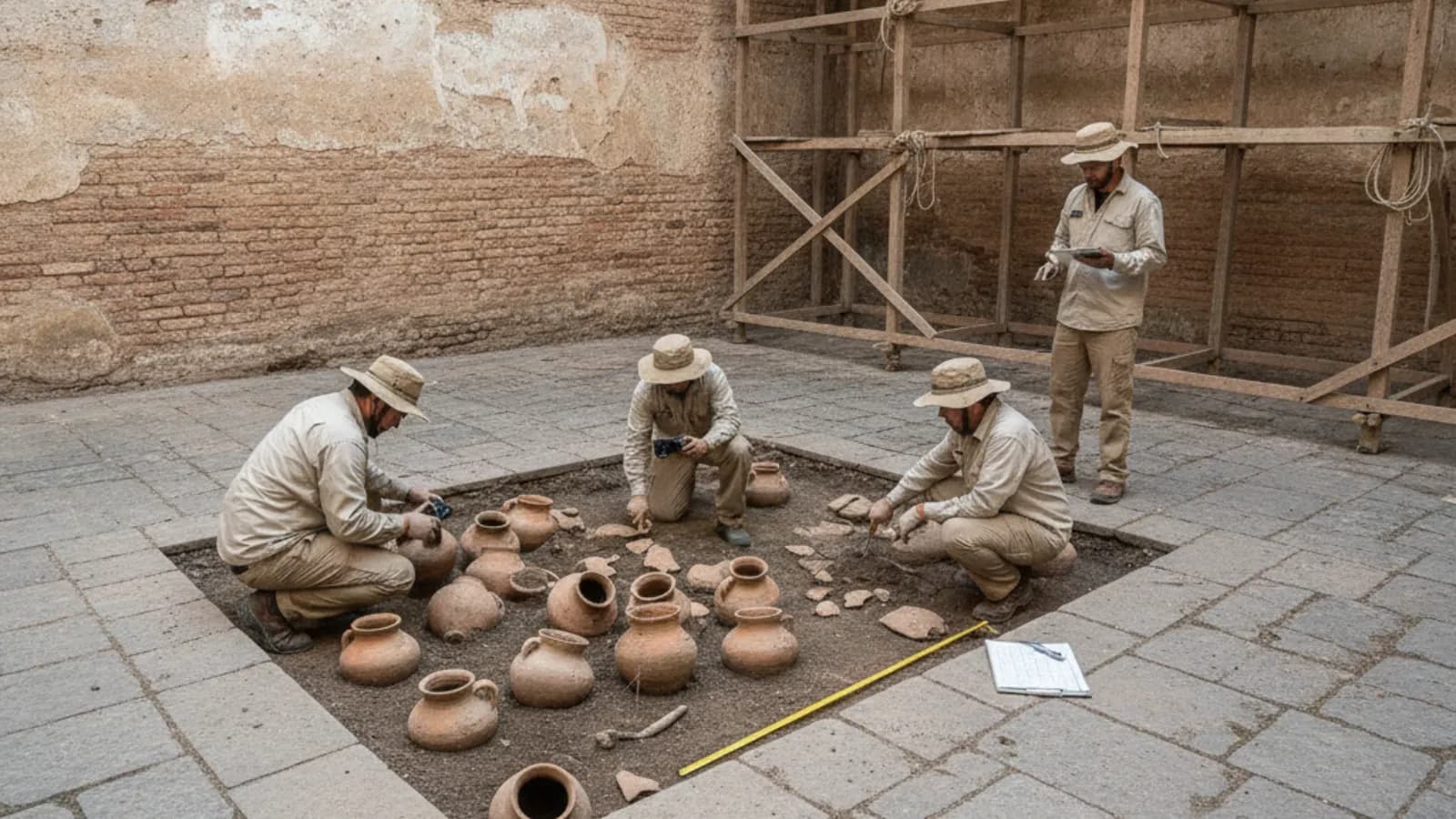
Restoration work at the former San Lazaro Hospital in Quito's Historic Center has uncovered 11 fired-clay vessels beneath the floor of the western cloister.
The discovery happened during archaeological monitoring while crews were clearing spaces and leveling floors. Workers first encountered two pieces, followed by two rows containing five and six vessels on opposite sides of the room.
Preliminary technical analysis dates the objects to the Colonial period. The fetched report does not establish what the vessels were used for, who placed them there, or whether they will eventually be displayed to the public.
A restoration with archaeology built in
The former hospital covers 7,000 square meters, and the full intervention is valued at more than USD 6.5 million. Because the building sits inside Quito's Historic Center and contains layers from different periods, construction is also an investigation of what survived under later changes.
Removing debris from the eastern and western cloisters exposed original stone-and-brick structures that had been hidden for centuries. That makes the vessels part of a wider architectural record rather than an isolated object find.
The Metropolitan Heritage Institute, known as IMP, is overseeing the heritage context described in the report.
Where the work stands
The cloister portion of the project was 12% complete after work began on June 12, 2026. Tasks include conserving adobe walls dating to 1785, treating moisture, waterproofing roofs, and installing new water, sanitation, and electrical networks.
Authorities expect the cloister infrastructure to be ready in January 2027.
The former chapel is further along. Its restoration stood at 40%, with completion projected for October 2026. Specialists are restoring murals on walls and ceilings and producing a replica of the main entrance door, which was completely lost in a fire.
Why this matters beyond the objects
Quito's Historic Center is easy to experience as a finished backdrop: plazas, churches, facades, and viewpoints. A project like San Lazaro shows the other side of conservation. Every floor level, wall, roof, utility line, and drainage problem can carry information that must be studied before the building is made useful again.
That slows the idea of restoration down in a good way. The goal is not merely to make an old structure look clean; it is to conserve the material that explains how the place changed over time.
What This Means for Expats
For residents and visitors interested in Quito's history, the find adds another reason to follow the San Lazaro project as it moves toward its 2026 and 2027 milestones. It does not yet create a new museum stop, and the source did not announce public access to the vessels.
The practical takeaway is to keep expectations measured. Archaeological discoveries can affect how work proceeds, but the report did not say the find changed the completion targets.
What is confirmed is already compelling: 11 Colonial-period vessels survived beneath a cloister floor while a major historic complex waited for restoration. The next thing worth watching is whether the IMP publishes a fuller interpretation and a plan for public display.
More in Culture
View all →Keep practical Ecuador coverage free to read.
Reader support helps fund source monitoring, translation, editing, publishing, and national coverage for expats across Ecuador.
Want to improve your Spanish? Learn online with native speakers on Italki. Learn more →
Comments
No comments yet. Be the first to share your thoughts!