What Ecuador Can See From The August 2026 Total Solar Eclipse

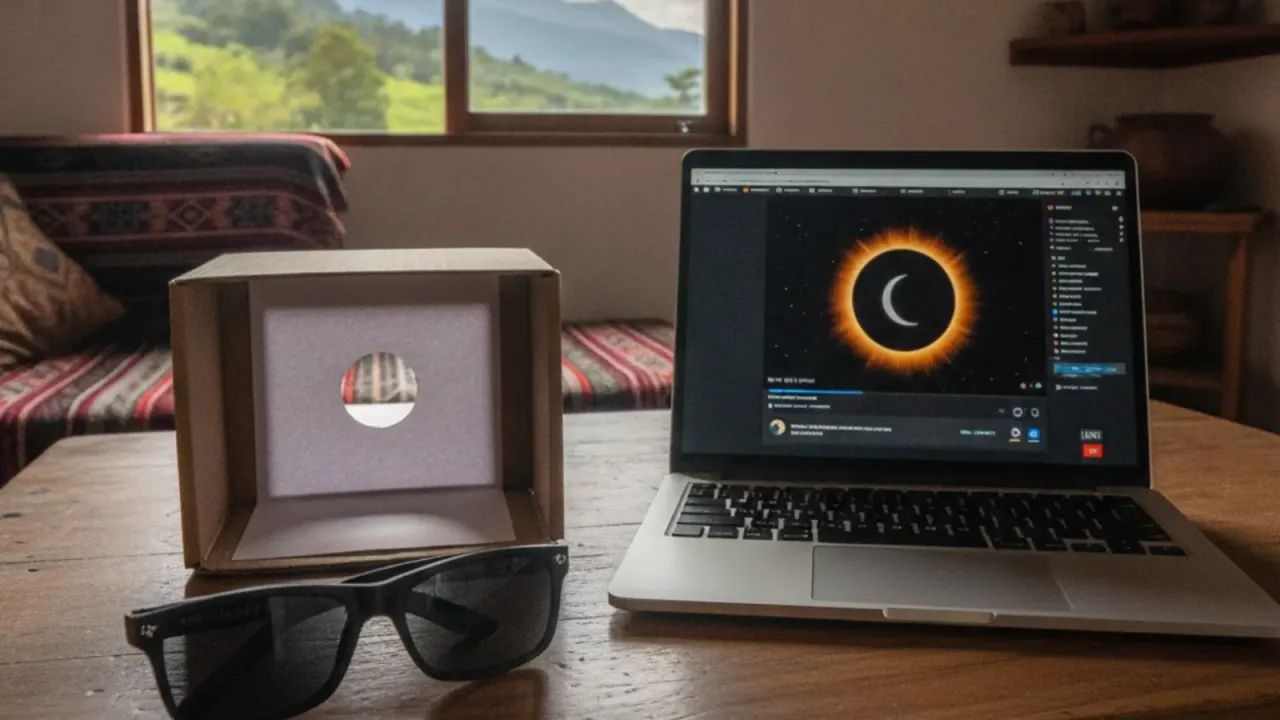
A total solar eclipse will cross parts of the Northern Hemisphere on August 12, 2026. Ecuador will not experience the daytime darkness of totality, but residents can follow the event through NASA's official livestreams.
The event occurs when the Moon covers the Sun for observers in the center of its shadow. The report describes totality as a short phase that usually lasts about two minutes and 18 seconds.
David Choez, a physicist and researcher associated with the Quito Astronomical Observatory, said an eclipse is an opportunity to observe details of the Sun's surface and the solar corona. The total eclipse will first be visible in Greenland, then Iceland and the Iberian Peninsula, with partial visibility across broader parts of Europe, North Africa, and some of North America.
The absence of local totality does not make the event irrelevant to Ecuador-based readers. A livestream can still make the timing and science accessible, and the date is a useful reason to plan a family or classroom viewing session around an official broadcast. The important distinction is between watching a screen and looking at the Sun itself. The latter requires proper equipment even when the eclipse is only partial.
The safety rule matters
Do not look at the Sun through a camera lens, telescope, binoculars, or another optical device without a solar filter on the front. Ordinary sunglasses are not safe for viewing an eclipse.
Solar viewers should meet the international ISO 12312-2 safety standard. The report also describes indirect viewing with a pinhole projector as an option, provided viewers do not look through the hole at the Sun. A pinhole setup projects the Sun onto a surface; it is not a viewing hole and should never be treated like one.
For people in Ecuador, the event is mainly a livestream opportunity rather than a local totality event. The useful date is August 12, and the useful preparation is knowing the difference between a certified solar viewer and everyday sunglasses. NASA's official stream is the simplest option for anyone who wants the experience without creating an eye-safety problem.
The event can still be a good prompt to talk about how eclipses work, especially for families with children or anyone studying science in Ecuador. The important practical distinction is that a livestream is viewed on a screen, while direct solar viewing requires equipment that meets the published safety standard. A phone camera, binoculars, or a telescope does not make the Sun safe to look at.
The report also notes that an exact eclipse of this type will occur again in 2044, while other eclipses will occur in 2027 and 2028 in different regions. Those dates do not change the Ecuador viewing plan for August 12, but they help explain why the event is receiving attention. For residents here, the safest plan remains simple: use the official stream, or use certified equipment and indirect projection rather than ordinary sunglasses.
More in Culture
View all →Keep practical Ecuador coverage free to read.
Reader support helps fund source monitoring, translation, editing, publishing, and national coverage for expats across Ecuador.
Need certified English-Spanish translations? EcuadorTranslations handles apostilled documents for visas and residency. Learn more →
Comments
No comments yet. Be the first to share your thoughts!